

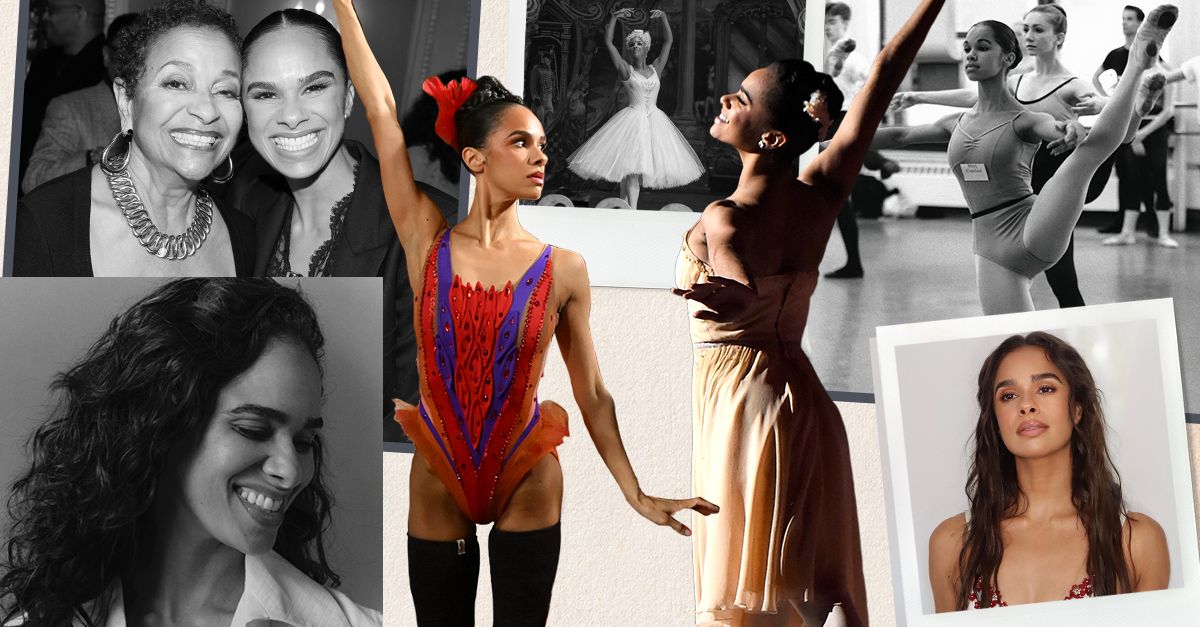
Misty Copeland on Her 25-Year Career and Taking a Final Bow Leave a comment
Welcome to En Pointe, a quarterly series that offers a deep dive into the intersection of beauty and dance through the eyes of up-and-coming, multidisciplinary dance talent. Expect an intimate look into the daily lives, dreams, and dance-bag beauty essentials of the industry’s best young performers.
It’s been over a decade since I last stepped into my light-flooded ballet studio that smelled faintly of resin, wood, and super-strength hair spray, but I still find myself easily slipping into the dance variations that I memorized like a prayer… tombé, pas de bourrée, glissade, jeté. Those four steps, among others, are how I habitually transport myself from one room to another in my house now that I’ve traded my Freed of London pointe shoes for the comfort of shearling slippers. I find myself reaching for the back of my couch as a makeshift ballet bar to help me balance as I absentmindedly stretch while my tea is steeping, and I always seem to think better when my hair is pulled away from my face into a bun at the crown of my head.
Sure, I may no longer be spending my Friday evenings icing my sore muscles after a week of classes and rehearsals, or sewing ribbons onto my pointe shoes like my life depends on it, but I don’t believe a ballerina ever truly stops being a ballerina. It gets woven into your DNA as soon as you fall in love with the art form and moves with you long after you step out of the spotlight for the last time. I consider myself fortunate to have dedicated years to training in it and to have done so in the same timeline as Misty Copeland, American Ballet Theatre’s first Black principal dancer. Copeland was the first dancer I truly remember seeing myself in and has remained one of my biggest inspirations as an artist. I caught up with Copeland to learn more about her career’s most defining moments, next steps, and beauty rituals.
Article continues below

Meet Misty Copeland: Former Principal Dancer at American Ballet Theatre and Writer
In the 25 years she has spent with American Ballet Theatre, she has not only given us some of the most stunning performances known to date (her heartbreakingly beautiful take on the wistful and naïve Juliet Capulet lives rent-free in my mind) but also paved the way for other brown ballerinas like myself to follow suit. Though she’s the definition of a “ballet prodigy,” Copeland didn’t start dancing until she was 13, but her meteoric rise in the dance world defied the centuries of tradition built to limit her success as a Black dancer. Her trailblazing career prompted a reexamination of many of the norms that had once been so accepted by the community, from pointe-shoe shades to reframing the largely European narrative of the ballet body.
On October 22, 2025, she retired with a stunning final performance of Sergei Prokofiev’s Romeo and Juliet balcony pas de deux with Calvin Royal III, Twyla Tharp’s Sinatra Suite with Herman Cornejo, and Wrecka Stow, a modern piece by Kyle Abraham at Lincoln Center. The event was watched by thousands in person and online. Two months later, she quietly underwent hip-replacement surgery. Most recently, however, Copeland made a surprise appearance at the 98th Academy Awards as part of the musical rendition of Ryan Coogler’s Sinners. She also appeared as a cover star for The Strength Issue—a collaborative platform by Aveeno and Togethxr with athletes Sophia Wilson, Cameron Brink, and Ali Truwit.

For me, it was bigger than just a chance to prove myself. It was about the Black community coming and being able to see themselves represented at the Lincoln Center (Metropolitan Opera House) on this stage where you don’t get to see us leading a ballet.
That said, Copeland didn’t initially dream of being a ballerina, but self-expression through any movement was like another language for someone as introverted as her. She was raised in a household that didn’t center communication through speech but elevated musicality and lyricism. As a high schooler, Copeland became captain of the drill team and caught the eye of her coach, who later encouraged her to refine her natural ability with training. Copeland’s ballet journey began on the basketball court at the Boys and Girls Club as part of a free program. “It wasn’t until I stepped into a ballet studio that it clicked. I finally felt like I was seen and like I had a voice that worked for me. I loved performing, which didn’t make sense to me, but for some reason, the technique of ballet gave me a new language,” says Copeland. On stage, she felt free, in control, powerful, and strong and knew early on that there would be no turning back for as long as she could dance.
While there are perhaps a number of defining moments in any dancer’s career when they feel as if they’ve discovered their truest potential, there’s normally one they can recall that also changed the trajectory of their career. For Copeland, it was when she was presented with the opportunity to perform the lead in Igor Stravinsky’s The Firebird. As a soloist, she was the first Black woman to perform that role in her company. “For me, it was bigger than just a chance to prove myself. It was about the Black community coming and being able to see themselves represented at the Lincoln Center (Metropolitan Opera House) on this stage where you don’t get to see us leading a ballet,” she explains.
At the time, Copeland and her manager were committing time to going to public schools in under-resourced and underrepresented communities and speaking about what it means to be part of a sport and an art form. For her performance in The Firebird, the audience was filled with those same communities showing up for her. “To see all of them turn up at the Met that night—it was so Black! It was such a shock to see a movement happen in real time toward diversity and inclusion in ballet,” Copeland explains. When one of the theater’s longtime janitors asked if these adoring audience members were all related to her, she responded by saying that while the 3000 people weren’t related, they were all considered family.
Setting the Stage for Change
Thirteen years later, when she decided to take her final bow as a principal at the American Ballet Theatre, Copeland felt at peace with her decision. The dancer decided that she would be the “architect” of what her program would look like, rather than leaving on anyone else’s terms—choosing on her own when the time was right. “I wasn’t about to be dragged out by my pointe shoes! I knew I was going to be in control and wanted it to be a moment where I would do roles that were really impactful for me,” she says. While she did see The Firebird as one of the most important roles she had taken on, she opted for the excerpt from Romeo and Juliet. She was originally supposed to perform the ballet with Royal as the lovelorn Romeo Montague in early 2020, but the COVID-19 outbreak prompted a delay.
To Copeland, taking on the role of Juliet Capulet offered an opportunity to expand her acting capabilities and effectively altered the way she viewed her artistry and the types of roles she imagined herself doing. “To be able to do it with Calvin as two Black leads for the first time in the company’s history was really important,” explains Copeland. She also chose to perform the Sinatra Suite as part of her farewell performance since Tharp’s work resonated with her since she was 16 when she had first been exposed to it. As for the high emotions of the night, she felt completely relaxed and set out with the intention of enjoying her time on stage while keeping her hip injury from worsening.

I wasn’t about to be dragged out by my pointe shoes! I knew I was going to be in control and wanted it to be a moment where I would do roles that were really impactful for me.
Copeland’s advocacy for inclusion and diversity in the ballet world didn’t conclude with her departure from American Ballet Theatre, and she regularly highlights individuals like Pacific Northwest Ballet’s Ashton Edwards, who is also a champion of change. “There are people that are part of the push for inclusion and want to see change, and things have progressed! The pandemic era, specifically, saw a lot of change happen in the ballet world,” says Copeland.
One of the biggest conversations that arose around equality in ballet was how darker-skinned dancers have to “pancake” their pointe shoes to make their skin tone. Copeland began pancaking her pointe shoes when she started dancing at 13. At first, as a professional dancer, she was provided with shoes made to order in her skin tone, but this ended after the company behind that made them decided the production cost was too high since no other dancers with her skin tone required them. Then, she shared a heartbreaking fact: The first time Copeland wore pointe shoes that she didn’t pancake herself was for the farewell performance. “It took 25 years of my professional career to see that change happen, and it was for my last performance,” she says. “Isn’t that crazy?” While major ballet schools and companies have begun to allow pointe shoes and tights in shades other than pink as the uniform nude color, it’s still not an industry standard.
Strength in Numbers
Copeland being featured on the cover of the Aveeno x Togethxr Strength Issue is a true testament to the athleticism of ballet as a sport and art form. While she sees her career as a professional dancer as the reason she’s built a platform and established a voice for change in the world of ballet, Copeland shares that she has also advocated for uplifting the voices and strength of women’s voices at the intersection of sports and dance. “As dancers, we are also athletes, but we aren’t always viewed that way. So when this partnership opportunity came about, it made perfect sense because it was with Aveeno and Togethxr, who I’m a big fan of for their work with female athletes.”
She reveres The Strength Issue as aligned with everything she’s pushed for in changing the narrative about how we talk about women’s strength and how it’s perceived. “As dancers, we put so much focus on our bodies through our training, and that’s at the forefront of everything we do. Ballet has taught me how important it is to have a ritual that sets you up for your day and puts your mind at ease,” she continues. Copeland sees her aging skincare ritual in a similar way. “My routine mirrors the way I look at a ballet class—I don’t want a ton of steps, but I want quality. For me, that’s moisturization,” she says. “At 43, I have spent so many years on stage with lights hitting my skin and have a lot of injuries. I love Aveeno’s Healing Ointment for them!”

(Image credit: Courtesy of Aveeno)
Shop Ballerina-Approved Aveeno Body and Skincare

Aveeno
Skin Relief Healing Ointment for Dry Skin

Aveeno
Skin Relief Moisturizing Lotion

Aveeno
Skin Relief Body Wash

Aveeno
Daily Moisturizing Body Wash

Aveeno
Daily Moisturizing Lotion

Aveeno
Positively Radiant Brightening Cleanser

Aveeno
Daily Moisturizing Face Lotion
